Infernal Council
Paradise LostThe Infernal Council is the central political assembly of Hell in Paradise Lost: a convocation of the fallen powers gathered at Pandemonium after the War in Heaven to decide whether they should renew open war, endure their punishment, or seek another means of revenge against God. Its importance lies in the contrast between collective procedure and concentrated ambition. The council speaks in the language of freedom, equality, public safety, and common inheritance, yet its decision becomes the instrument of Satan's personal design against mankind.
Constitution and Setting
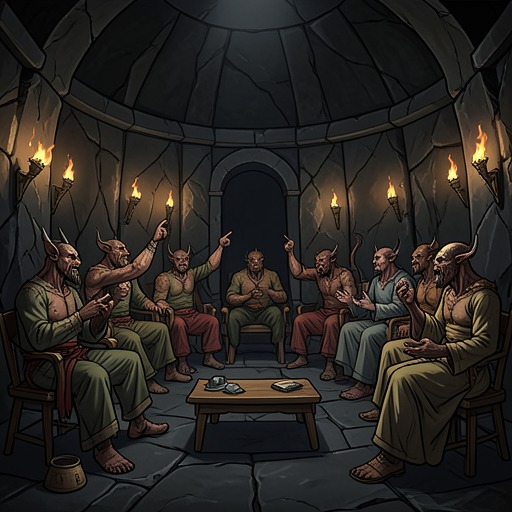
The council is summoned by winged heralds acting under Satan's authority, who proclaim that a solemn meeting will be held at Pandemonium, described as the high capital of Satan and his peers. The summons reaches every banded and ranked regiment, calling the worthiest representatives from the rebel host. The assembly therefore possesses a formal, selective character: it is not merely a mob, but a gathering of eminent leaders chosen by place or merit, attended by hundreds and thousands as the entrances and porches become crowded. The hall itself magnifies the council's political theater. It is so vast that it resembles a covered field in which armed champions might ride before a ruler's chair, yet the incorporeal spirits reduce their immense forms until they can fit into the confined space. The great Seraphic Lords and Cherubim retain their larger dimensions in a private recess, where a thousand demigods sit on golden seats in a secret conclave. The scene combines imperial magnificence, military hierarchy, and parliamentary deliberation: rank is displayed, bodies are ordered, and debate begins only after silence and the reading of the summons.
Debate Over War and Settlement
Satan opens the proceedings from a throne whose splendor exceeds the riches associated with the East. He presents his elevation as justified by merit, leadership, free choice, and achievements in counsel and combat. Although Hell is a place of pain, he argues that the fallen have recovered enough political stability to establish a secure throne and a firm union. The central question is whether their lost inheritance should be pursued through open war or covert guile. Moloch advocates immediate open war. As the strongest and fiercest spirit who fought in Heaven, he rejects delay and calls for the armed host to assault Heaven's towers with Hell's fire and fury. His proposal is driven by impatience with exile and by contempt for fear: the rebel millions, he argues, are already armed and waiting for the signal. Moloch would convert despair into direct action, even though the proposal risks another defeat. Belial offers the opposite counsel. His speech clothes ignoble ease and peaceful sloth in the appearance of reason. He accepts that the rebels cannot resist the divine decree and advises them to endure their present suffering rather than provoke worse punishment. He imagines that time might soften God's anger, that the fires might slacken, and that their fallen essence could gradually adapt to Hell until darkness becomes light and pain becomes familiar. His apparent moderation is therefore not peace founded on reconciliation, but passive accommodation to bondage. Mammon develops a more active version of withdrawal. He rejects both the hope of overthrowing the King of Heaven and the prospect of returning as humbled subjects under a renewed grant of grace. To worship the ruler they hate, he argues, would make eternity itself a wearisome spectacle of servile praise. Hell, by contrast, can become the ground of self-reliance: its darkness contains hidden gems and gold, its inhabitants possess enough art to raise magnificence, and labor may create ease out of pain. The applause that follows shows that the council fears another field of battle while desiring to found a durable nether empire in opposition to Heaven.
Beelzebub's Proposal and the Council's Decision
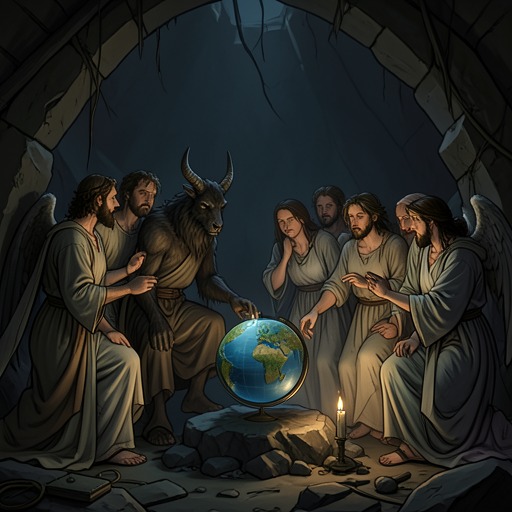
Beelzebub rises with the bearing of a statesman, his face marked by deliberation and public care. He challenges the assumption that Hell can become a secure retreat beyond God's jurisdiction. The King of Heaven remains sovereign in height and depth, ruling Hell with an iron scepter just as he rules Heaven with a golden one. Since war has already determined the rebels' condition and no acceptable terms of peace have been offered, the council must seek an easier enterprise than a direct assault on Heaven. Beelzebub identifies a possible second world, the future seat of a new race called Man. According to ancient and prophetic report, these creatures will be made in the likeness of the heavenly powers but will possess less power and excellence while receiving greater favor from God. Beelzebub proposes investigation rather than immediate attack: the rebels should learn the new creatures' substance, powers, and weaknesses, then determine whether force or subtlety will work best. The proposed action carries several possible outcomes. Hell might use fire to waste God's creation, seize it as its own, drive out its inhabitants, or seduce them into the rebel party so that God would become the destroyer of his own works. The design is expressly vindictive. It would disturb God's joy, turn his favored sons against their fragile origins, and mingle Earth with Hell. The narrator identifies the plan as first devised by Satan, even though Beelzebub presents it to the assembly. This distinction reveals the council's political method: Satan's private malice is converted into public counsel and then authorized as a collective enterprise. The proposal receives full assent. The infernal states vote for it, and Satan declares that their long debate has ended in a resolution worthy of their former greatness. The council's decision promises to lift them from the lowest deep, perhaps bring them near Heaven's bright confines, or at least establish them in a milder region where light and air might heal the scars of the corrosive fires. Yet the grand ambition conceals a practical problem: someone must cross the dark abyss, evade the angelic sentries, and find the happy island of the new world.
Selection of the Envoy
When Beelzebub asks who can undertake the voyage, the council's confidence collapses into silence. The proposed route passes through an unbottomed abyss and palpable obscurity, while the traveler must endure the vast distance, the hazards of unknown regions, and the stations of Angels watching around the new world. None of the chosen champions volunteers. Each reads dismay in the faces of the others, and the collective body proves unable to assume the risk it has collectively authorized. Satan then offers himself. He argues that a ruler must accept a share of danger equal to his share of honor, and a greater share of hazard because he occupies the highest seat. He orders the others to remain in Hell, ease its present misery, and maintain vigilance against the wakeful foe while he searches alone through the coasts of darkness for deliverance. His refusal to share the enterprise is both heroic and politically calculated: he prevents a rival from gaining cheap glory by volunteering for a mission he intends to control. The council accepts this performance as self-sacrifice. The fallen spirits rise with Satan, bow in reverence, and praise him as a godlike chief who has disregarded his own safety for the general welfare. The Infernal Council thus ends with apparent concord. Its members disperse into military games, races, contests, music, and philosophical discussions, while Satan's return is awaited. The narrator's comparison between their firm agreement and human quarrels gives the assembly an ironic dignity: even the damned can maintain concord, whereas human beings, despite the hope of heavenly grace, persist in hatred and war.
Authority, Freedom, and Political Irony
The Infernal Council repeatedly borrows the vocabulary of liberty while preserving the structure of monarchy. Satan describes the fallen as united by free choice and shared merit; Mammon prefers hard liberty to an easy yoke; and the larger rebel cause treats submission to God as servile pomp. Yet the council is presided over by Satan, whose throne, titles, and imperial display reproduce the hierarchy the rebels claim to reject. Its deliberation does not abolish domination; it relocates domination from Heaven to Hell. This contradiction is sharpened by the broader heavenly debate recalled by Raphael. Satan had argued that the Angels were naturally free and equal and should not bend the knee to the Son of God. Abdiel answered that service to the worthiest ruler is not servitude, whereas serving an unwise or rebellious master makes the servant enslaved to himself. The Infernal Council embodies that warning. Its language of emancipation becomes an instrument of self-enthrallment, because its members submit to Satan's ambition while imagining that they are acting for common liberty. The council also provides a political counterpart to the divine assemblies in Heaven. At a heavenly convocation, God announces the Son's authority, and later the Father determines the end of the War in Heaven by assigning judgment to the Son. The Infernal Council, by contrast, responds to defeat through improvisation, persuasion, and revenge. Its decisions are real within the plot, but they cannot escape the sovereignty of God, who remains ruler over Hell and permits the council's movement toward the fulfillment of a larger purpose.
Consequences and Narrative Significance
The council's immediate consequence is the transformation of defeat into a mission: instead of attempting another impossible assault on Heaven, Satan will travel toward the new world and seek mankind's ruin. Its political success is therefore inseparable from its moral failure. The assembly finds a common policy, but that policy is founded on envy, malice, and the desire to make God suffer through the corruption of his favored creation. Its later significance is visible in the contrast between infernal and heavenly decision-making. The council's debate produces false presumptuous hope, and its members disperse to distract themselves from restless thoughts while their chief undertakes the dangerous journey. In Heaven, by contrast, divine judgment incorporates both punishment and a future provision for mankind: the Son offers his life for human guilt, and God later orders Michael to expel Adam and Eve from the Garden while revealing a covenant of future redemption. The Infernal Council cannot foresee that its revenge will become part of a history in which grace, atonement, and restoration exceed Satan's intended harm. The organization therefore stands as a durable image of political intelligence severed from rightful order. It can build a capital, convene ranked representatives, conduct debate, generate consensus, and formulate strategy. It can even display courage, eloquence, and solidarity. But its collective reason remains directed toward opposition for its own sake. The council's final achievement is not independence from Heaven, but the creation of a coordinated path by which Satan's private rebellion reaches the human world.